
Showing posts with label Visitor Sites. Show all posts
Showing posts with label Visitor Sites. Show all posts
Tuesday, 1 July 2014
China Hat (Sombrero Chino)


Tuesday, 11 February 2014
Santa Cruz Island - Academy Bay - Clearest Waters in the World
 |
| Puerto Ayora, Academy Bay |

 |
| Crystal Clear Waters of Academy Bay |
Tuesday, 31 December 2013
Pinta Island - The Northernmost Island
 |
| Satellite View of Pinta Island |
Pinta Island (also known as Abington, but better known as named after Columbus' ship The Pinta) is a tiny spot representing less than 1% of the entire Galapagos land reserve (it is just 60 km in area). Its highest point is 2550 feet above sea level. Pinta is a shield volcano with numerous young cones and lava flows. Not only is Pinta the most northern of the Galapagos Islands, but also it hosts no visitor sites, other than one boat landing site, used primarily by scientists, on its northern shore called Punta Neros.
 |
| Volcanic Formations on Pinta |
Wednesday, 11 September 2013
Why Can't I See That Animal - Camouflage on the Galapagos Islands
 |
| The heads of these marine iguanas basking in the sun look just like the surrounding rocks. |
Familiar phrases, but what do they mean? In the simplest terms, they mean that animals have, over time, changed in ways that give them the ability to survive despite challenges in their environment. One such adaptation is the ability to change color to blend into the surrounding landscape, thus offering protection from predators. The volcanic land masses on the Galapagos Islands are predominantly shades of earthy tones in browns, tans, blacks, siennas, whites, grays and dusty greens. With few exceptions, this means the birds and wild life blend into their surroundings, protecting them from hawks and other prey.
In this post, I share with you some of my photos that graphically show how millions of years of adaptation protect our precious life forms.
 |
| You might walk by this bird's nest dozens of times before realizing its presence. |
 |
| A little boobie chick hiding in the bushes. |
Sunday, 19 May 2013
It's May - Paradise for Waved Albatross
This is a most exciting time of year for Punta Suarez on Espanola
Island. Though there is never a bad time to visit this island, in springtime, visitors get to see all of the Waved Albatross in the world settle here, engage in their ritual dance, mate, and care for
their babies. I've written
about Punta Suarez before. See that post, here. And, I'm sure you'll hear more about it
again, because it differs from season to season. Sometimes the blue
footed boobies' nursery is the centerpiece. Now though, in springtime,
it's the amazing, wondrous Waved Albatross.
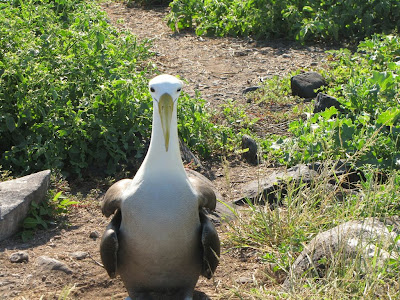
Here's one now - greeting us head on - completely unafraid - posing for the camera.
Mariners have long associated albatross with good luck
because when a sailor sees an albatross, land is near. If you visit Punta Suarez on Espanola Island from
the beginning of spring through November, and see these dramatic and unique
birds, you’ll believe that they bring good luck too. Your landing by panga on Espanola will barely
hint at the wonder you are about to experience.
The initial path is rocky and dry, typical of the volcanic formation of
the Galapagos Islands. Soon though it
opens up to a gorgeous view of the Pacific Ocean, pounding seas, dramatic blow
holes, and, most special of all, the world’s only Waved Albatross mating area.

Here's one now - greeting us head on - completely unafraid - posing for the camera.
 |
| Mating Area |
Sunday, 19 August 2012
Genovesa (Tower) Island Visitor Sites
 |
| Genovesa Island - Darwin Bay Photograph from Galapagos National Park Service |

 |
| Frigate Bird Chic |
Monday, 13 August 2012
Floreana Island
 |
| Sorting the Mail at the Post Office on Floreana Island |
Post Office Bay and Floreana Post Office
 |
| Evidence of Previous Visitors to the Post Office |
Thursday, 9 August 2012
Fernandina Island - Espinosa Point and Mangle Point
 |
| Fernandina on the Left; Isabela on the Right Photograph From WikiCommons |
 |
| Fernandina's Core Erupting in 2009 from Nasa Image |
Bartolome Island - Pinnacle Rock and Beautiful Beaches
 |
| Bartolome Island; Pinnacle Rock Photographed by AquaSurround |
 |
| Steps on Bartolome with Galapagos Hawk Above Photograph by AquaSurround |
Sunday, 29 July 2012
San Cristobal Island, Nearby Visitor Sites
 |
| Kicker Rock at Sunset |
While the sites on the island itself are all treasures, the beauty and magic of what lies a short boat ride from the harbor is truly dazzling. The first of these sites, and truly an iconic place in all of the Galapagos Islands, is Kicker Rock, sometimes called Leon Dormido. This is such a spectacular location, breathtaking at any time of day, that it warrants an entire post of its own, Kicker Rock.
Thursday, 26 July 2012
San Cristobal Island Visitor Sites
.JPG "The Hillside and Center of Puerto Baquerizo Moreno on San Cristobal from the Harbor at Sunrise") |
| The Hillside and Center of Puerto Baquerizo Moreno on San Cristobal from the Harbor at Sunrise |
The beautiful and versatile San Cristobal Island is one of the most eastern and oldest of the Galapagos Islands. It is moderately-sized, at 195 square miles. But, that land area is filled with some of the most visited and remarkable sites anywhere in the world. This versatility also accounts for the fact that San Cristobal is the second most populated of the Islands; about 8000 people live on San Cristobal. While all of the Galapagos Islands is dedicated to conservancy and maintaining the tenuous ecological balance discovered by Charles Darwin, nowhere is this more true than the Island of San Cristobal itself. It is a forerunner in the quest for renewable energy; at least 60 percent of its energy already is generated by wind and solar power. You will see the wind towers from the harbor and as you drive throughout the island.
Subscribe to:
Posts (Atom)