Showing posts with label Santa Cruz. Show all posts
Tuesday, 2 June 2015

Search Dogs Essential to Galapagos Efforts to Keep Out Harmful Invasive Species

African Snail from Freerepublic.com
Once Galapagos was pure and unspoiled. And, it remains the most protected and environmentally conscious area in the world thanks to strict rules and regulations. But, that does not mean that we are isolated. Far from it. From the earliest landings by pirates until today with the influx of tourists, species that are not in sync with the ecosystem and natural environment have been a problem. We are forever being threatened by species that are neither endemic nor natural to Galapagos. So, the Galapagos National Park and Marine Services, the Charles Darwin Research Center and myriads of other organizations and academic institutions are working hard to assure our environment remains stable and free from dangerous outside forces.

I love reporting to you about the wonderful conservation work being done throughout the Galapagos Islands to secure this beautiful paradise and keep it from harm. Rats have been conquered by human intervention, as have goats and feral cats. When it comes to insects that threaten certain plants, researchers take exceptional steps to find exactly the right antidote while safeguarding surrounding foliage. Penguins are helped with nesting; baby mangrove finches are protected from invideous insect eggs. It seems that even the giant tortoises are helping with preservation by absorbing certain invasive plants into their diet and thus preventing them from spreading. 

Tuesday, 8 April 2014

Charles Darwin Research Station - Fifty Years of Conservation

Charles Darwin Research Foundation
A "must see" destination for any visitor to the Galápagos Islands is The Charles Darwin Research Station. Once known primarily as the home of Lonesome George, now that George is gone, visitors are recognizing it for so much more: a major center for scientific study and the preservation of all species on the Galapagos Islands.


The scientists and conservationists responsible for founding the CDRS showed tremendous insight and foresight.  Long before conservation and sustainability were trendy, the CDRS saw that human intervention was needed to assure survival of the diversity and uniqueness of the Galapagos Islands.

Tortoise Breeding Project
This endeavour started in the 1950s when a young researcher, Irenäus Eibl-Eibesfeldt, came to the Galapagos Islands and became fascinated by the uniqueness of the islands fauna and flora, but likewise concerned about its future survival and the need for conservation.  He shared his findings with the International Union for Conservation of Nature (IUCN), among other organizations, and strongly advocated for a biological research station for study and laboratory experimentation. Originally established as a center for tortoise breeding projects, CDRS has expanded to the forefront of organizations determined to protect endangered species and restore them to unprotected status.
Tuesday, 11 February 2014

Santa Cruz Island - Academy Bay - Clearest Waters in the World

Puerto Ayora, Academy Bay
If you haven't been to Academy Bay, it deserves a visit.  Located just outside of Puerto Ayora, it is the most populous location in the Galapagos Islands.


Crystal Clear Waters of Academy Bay
Not only that: Academy Bay has been ranked as one of the most crystal clear beaches in the entire world.


Monday, 6 May 2013

Santa Cruz Island - Black Turtle Cove

Santa Cruz Island, Black Turtle Cove Panorama
Santa Cruz Island, Black Turtle Cove Panorama from Wiki
Located on the northern shores of Santa Cruz Island, Black Turtle Cove is a very special place; the atmosphere is quiet, contemplative and visual. Galapagos National Park rules require that upon your arrival at Black Turtle Cove via panga, the motor be turned off.  Silence and stillness permeate.  That is until you start to hear the sounds of nature all around you. Listen to the birds, hear the water and waves, listen for the sounds of fish jumping in the still waters, look around and smell the greenness of the mangrove trees that surround this beautiful area. In the panga you will navigate into the cove and then through the mangrove forest, sometimes paddling so as not to disturb the wildlife. The approach to the wildlife in silence assures that the nesting green sea turtles, sharks, herons and rays are allowed to remain peaceful and undisturbed in their natural habitat.

Approach to Black Turtle Cove
The mangroves themselves are beautiful, dense and diverse. Some are old; some new. They are not all alike; in fact, there are three mangrove species at Black Turtle Cove. Their root systems merge directly into the shallow blue saltwater of this cove. Their colors vary and the leaves sparkle where they are hit by the tropical sun.

Monday, 15 April 2013

Santa Cruz - Charles Darwin Reseach Station


Entrance to Charles Darwin Research Station
Entrace to CDRS by Scott Abelman
The Charles Darwin Research Station on Santa Cruz Island near the town of Puerto Ayora, is one of the best known and most visited sites in all of the Galapagos. The CDRS is a joint effort of the Charles Darwin Foundation and the Galapagos National Park Service to protect, conserve, keep from extinction and repopulate the many Galapagos Tortoise species that are endemic to the islands.


Lonesome George and a Petite Female Galapagos Tortoise
George and a Female
CDRS was created in 1964 and its tortoise preservation program initiated in 1965. From 1971 until his death in June 2012, CDRS was the home of the biggest celebrity in the Galapagos Islands, Lonesome George. George, who lived at the CDRS for more than 40 years, was the last extant tortoise from Pinta Island and had, for many years, been the focus of concerted efforts to breed him with other similar, but not identical, tortoises. Unfortunately, all efforts failed and when George died, so did the species. For an extensive discussion of Lonesome George and the efforts to reproduce the species see my earlier post written right after his death
Monday, 18 March 2013

Santa Cruz Island - Bachas Beach

Beautiful White Sand Bachas Beach

Bachas Beach on Santa Cruz Island is the first stop on many cruise itineraries, and a perfect place to introduce you to the Galapagos Islands. Here, from a beautiful white sand beach, you will be exposed to part of the rich human history of the Islands, both land and marine iguanas, nesting Galapagos green sea turtles, endemic flora, Sally Lightfoot Crabs, flamingos and pelagic birds, all to be topped off with a swim in the Pacific Ocean, replete with gorgeous vistas and the Galapagos blue sky. Heaven!

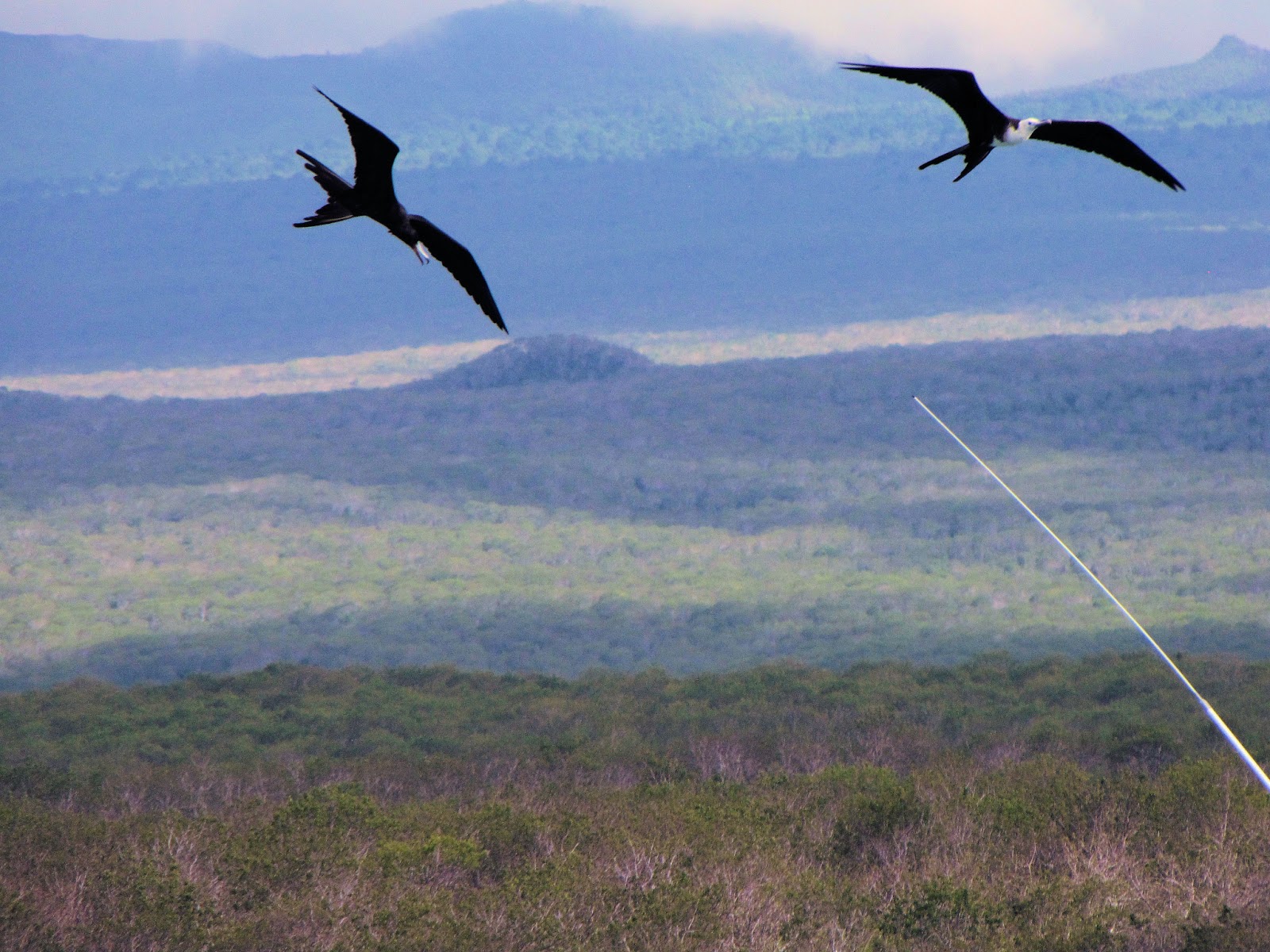
Frigate Birds Fly Above Bachas Beach
So, let’s begin our Bachas Beach journey. From your cruise ship, you will take a panga to a wet landing, meaning your feet dip into the Pacific Ocean for the first (but certainly not the last) time on your visit. You arrive on a pristine white sand beach and feel the warmth of the sand and sun. The walk here is not strenuous, but an opportunity to let the surroundings pull you in, to relax, to feel the uniqueness of the world around you and to put yourself in the moment - a place you will want to be throughout your Galapagos visit.