Thursday, 10 September 2015

Frequently Asked Questions: What Should I Pack for my Galapagos Trip?

Packing for Galapagos can be something of an art form depending upon how long you are staying and some of your personal preferences. Here are a few thoughts to keep in mind as you get started:


Know how your day is likely to be arranged on a typical Galapagos cruise. Your day will generally be:
  - breakfast
   -a land-based activity, usually a hike but sometimes in Santa Cruz or        San Cristobal
   - lunch
   - snorkeling
   - another hike
   - a briefing and dinner


Thursday, 3 September 2015

Frequently Asked Questions: How Much Should I Tip on a Galapagos Cruise Ship

This is the first of a series of blog posts in which I will focus on frequently asked questions about travel to Galapagos. Of all the questions I get, the most common is, "Should I tip on the cruise ship and, if so, how much?"


It might appear that, as a guide, I have a conflict of interests. So, when directly asked "How much?" by a cruise ship guest, I typically say something to the effect, "We always appreciate a tip and the amount is up to you." 

The truth is that the crew and guides on cruise ships usually do get tipped and rely on tips to supplement their income. Galapagos is a very expensive place to live; many things cost three times more than on the mainland. But, cruise ship salaries of guides and crew do not reflect that economic reality. This might be something to keep in mind when tipping.


Monday, 24 August 2015

Galapagos and Beyond: Tortoise Population Recovery is a World-wide Effort

Giant Galapagos Land Tortoise
Our giant land-based endemic Galapagos Tortoises are a “must see” feature for most Galapagos visitors. Giant tortoises and the Galapagos Islands are, in many ways, synonymous, particularly when you consider that our islands are named in their honor. When the first explorers came to these islands and saw the hundreds of thousands of saddle back giant tortoises, they named the islands to reflect their discovery as the word “galapagos” means saddle in Spanish.


Tagus Cove Graffiti Reminds Us of Plundering Pirates

Of course, history now tells us that the same people who first came here and became so enamored, later destroyed the very tortoise population that intrigued them from the beginning. Pirates and other seafarers took tortoises by the hundreds, and even thousands, and threw them into the holds of their ships to eat, use for oil, and take home for trading. Many of the tortoises died on their journey, only to be thrown back into the sea.  Mankind also was a further catalyst for the reduction and extinction of the giant tortoise population when we introduced non-endemic species such as goats and rats to the islands. These predators soon attacked and ate the hatching tortoises.
Tuesday, 2 June 2015

Search Dogs Essential to Galapagos Efforts to Keep Out Harmful Invasive Species

African Snail from Freerepublic.com
Once Galapagos was pure and unspoiled. And, it remains the most protected and environmentally conscious area in the world thanks to strict rules and regulations. But, that does not mean that we are isolated. Far from it. From the earliest landings by pirates until today with the influx of tourists, species that are not in sync with the ecosystem and natural environment have been a problem. We are forever being threatened by species that are neither endemic nor natural to Galapagos. So, the Galapagos National Park and Marine Services, the Charles Darwin Research Center and myriads of other organizations and academic institutions are working hard to assure our environment remains stable and free from dangerous outside forces.

I love reporting to you about the wonderful conservation work being done throughout the Galapagos Islands to secure this beautiful paradise and keep it from harm. Rats have been conquered by human intervention, as have goats and feral cats. When it comes to insects that threaten certain plants, researchers take exceptional steps to find exactly the right antidote while safeguarding surrounding foliage. Penguins are helped with nesting; baby mangrove finches are protected from invideous insect eggs. It seems that even the giant tortoises are helping with preservation by absorbing certain invasive plants into their diet and thus preventing them from spreading. 

Tuesday, 26 May 2015

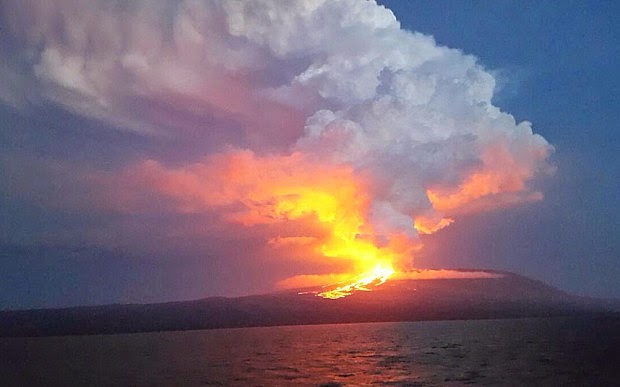
Volcan Wolf Erupts on Isabela Island

Volcan Wolf is erupting right now on Isabela Island for the first time since 1982. It's a spectacular sight to see. 


No human population will be harmed by the eruption. Importantly, the Galapagos National Park Service is reporting that our endemic pink iguana population is not currently at risk. It has been reported that the lava is flowing down the volcano's southern face but that the iguanas inhabit the other side of the volcano. The lava appears to be flowing into the sea, and there is no prediction as yet regarding any effect on marine life near the base of the volcano.


Visit the Galapagos Eco-Lodge facebook page for updates and our blog for more information about Volcan Wolf and our unique pink iguanas.http://blog.galapagosecolodge.net/2013/02/no-two-galapagos-iguanas-same.html; http://blog.galapagosecolodge.net/2012/10/isabela-island-visitor-sites-part-iii.html