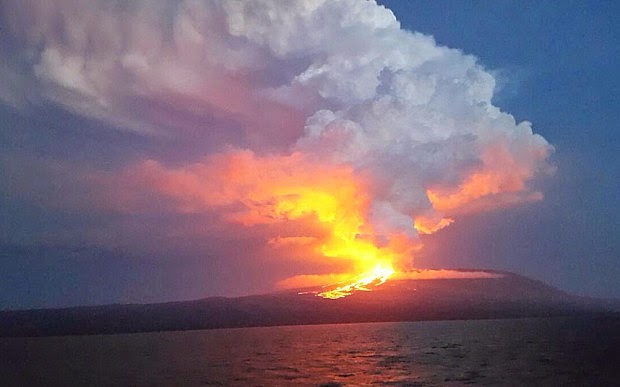
Volcan Wolf is erupting right now on Isabela Island for the first time since 1982. It's a spectacular sight to see.
No human population will be harmed by the eruption. Importantly, the Galapagos National Park Service is reporting that our endemic pink iguana population is not currently at risk. It has been reported that the lava is flowing down the volcano's southern face but that the iguanas inhabit the other side of the volcano. The lava appears to be flowing into the sea, and there is no prediction as yet regarding any effect on marine life near the base of the volcano.
Visit the Galapagos Eco-Lodge facebook page for updates and our blog for more information about Volcan Wolf and our unique pink iguanas.http://blog.galapagosecolodge.net/2013/02/no-two-galapagos-iguanas-same.html; http://blog.galapagosecolodge.net/2012/10/isabela-island-visitor-sites-part-iii.html
Tuesday, 26 May 2015
Tuesday, 14 April 2015
Sea Lions Too are Mama's Boys!
Male baby sea lions stay close to and rely on their moms for a much longer period than their female peers. Long after the little boys grow big enough to be capable of hunting and fishing, they still laze around dependently on their moms far after their sisters have ventured out on their own and learned to forage. It seems that the males have it made from a physical and (from what we as humans would refer to as a psychological) point of view.Tuesday, 7 April 2015
David Attenboro's Galapagos Adventure
I know from personal experience that there can never be too many photographs of the magnificent and diverse menagerie that inhabits the Galapagos Islands. Here in Galapagos you will see an abundance of animals, birds and marine life. Not only that, it's almost impossible to take a bad photograph of the bounty that lives throughout Galapagos on the land and in the sea. And within that array, one baby sea lion after another presents a unique photo opportunity. Every so often, extraordinary photos are taken and shared with all of us, making our Galapagos vision even more exciting, inviting and memorable.
Tuesday, 10 March 2015
Wednesday, 21 January 2015
Baby Tortoises Hatched on Pinzon Island
![]() |
| Pinzon Saddleback Tortoise |
I've talked before about unwanted introduced species in Galapagos and efforts to eradicate them. One of the most invasive of these species were rats. They've been around for centuries really. Most likely, they were brought here on pirate ships. The ships layed anchor, the rats left the boat and swam to shore and there, they lived and dined like kings, particularly on the youngest of our species. Tortoises hatchlings, sadly, made a delicious meal and, as the babies died, so did the species. This was true in many places, particularly on Pinzon Island.
Labels:
galapago tortoises,
Galapagos,
Galapagos Islands,
Pinzon
Subscribe to:
Posts (Atom)