Showing posts with label Wild Life. Show all posts
Tuesday, 18 February 2014

What to Expect on Your Trip to the Galapagos Islands


Photograph of Harry Jimenez, owner of Galapagos Eco Lodge
I’ve lived on the Galapagos Islands all of my life and I’ve led nearly 1,000 groups of tourists to places throughout these remarkable islands. It goes without saying that I have learned many things in these years. But, above them all is this: Come to the Galapagos Islands prepared to expect the unexpected! The Islands never cease to amaze me. I always find something new, something inspirational and something I never anticipated.


Kicker Rock outside of San Cristobal Island
Kicker Rock
Just an hour's boat ride from the Galapagos Eco-Lodge
It’s likely that the greatest thrills you will have on your visit to the Galapagos Islands will be unforeseeable and unpredictable. For me, the moment that takes me by surprise and opens my eyes is as likely to happen when I am snorkeling as when I am awed by an an eye-catching vista; it could be when I open my eyes in the morning to an extraordinary sunrise or my last glimpse of the night sky when I see a shooting star. Sometimes, everything around me goes quiet and I hear nothing but the water, the wind, the birds and the sea lions. People fade into the background for that moment in time and I am at peace and feel the beauty, grandeur and uniqueness of my environment.
Wednesday, 12 June 2013

Galapagos Flightless Cormorant - Unique in All the World


Galapagos Flightless Cormorant
What a wondrous creature – the Galapagos Flightless Cormorant (Phalacrocorax harrisi). There is nothing like it anywhere else in the world. It epitomizes the meaning of species adaptation and is one of the most unique and interesting birds anywhere on Earth. With its long neck, grace and gentle demeanor, it's a favorite attraction for all Galapagos visitors. Look at those piercing blue eyes.


Galapagos Flightless Cormorant
Photo by David Cook Wildlife Photography
There are cormorants found all over the world and all species of
cormorant are marine birds that source their food from the sea. With one exception - our unique and remarkable cormorant -  cormorants fly above the ocean and dive down to catch the fish on which they survive. Once, our cormorant too flew, just like the other 27 species of cormorants found around our planet. Yet, over time, our unique and beautiful creature evolved and adapted to the rugged and arid volcanic terrain surrounded by salt water that defines the Galapagos Islands.


Wednesday, 13 February 2013

No Two Galapagos Iguanas the Same - A Photographic Review


Galapagos Island IguanaIguanas are one of the most ubiquitous and interesting characters in the Galapagos Islands. In reading my earlier post, you will have learned that they are the only ones who forage on both the land and in the sea.


But, here’s another very interesting fact: the iguanas on each and every island are different. They have adapted to their environments in coloration and size based on the available food sources as well as the lava rock on which they rest and camouflage themselves. Here, through photographs, are examples of the colors and differences of the iguanas on many of the Galapagos Islands.

Fernandina:


Iguana and Lava Lizard, Espinosa Point, Fernandina
Resting Iguana, Urbina Bay, Fernandina


Marine Iguanas Basking in Fernandina Sunshine

Sunday, 16 December 2012

Boobies Dive Bombing for Their Dinner

http://blog.galapagosecolodge.net/2012/07/espanola-island-punta-suarez_21.html
Ask any visitor to the Galapagos Islands what they loved about their trip and they are bound to tell you all about our fabulous Blue Footed Boobies. I mention them in many of my posts because we see them on every Island. Typically when I write about those funny, clown-like and fascinating inhabitants of the Galapagos Islands, I talk about their mating habits and their adorable and irresistible little chicks. Any one lucky enough to experience their mating dance will have a memory to last a lifetime. I show this ritual in my Espanola Post.

I'm often asked why these birds have blue feet. It's a particularly intriguing question because almost every Galapagos animal or bird species blends into the stark volcanic environment with its pallet a range of brown, beige, sepia, and black, interspersed with green scruffy plant life. How then did they end up with bright blue feet - and electrifying color in contrast to the earthy tones? The answer goes right back to the mating ritual. The males strut around displaying their feet to the females who, in turn, are attracted to that azure color. The bluer the better and more magnetic. The Boobies' feet serve the same purpose as the coloration of so many male birds, like cardinals or frigatebirds.
Thursday, 6 December 2012

Galapagos Sea Lions - They Are Definitely Not Seals!

Sea Lion Basking on a Bench in Puerto Baquerizo Moreno, San Cristobal, Galapagos Islands
Sea Lion Basking on a Bench in Puerto Baquerizo Moreno
Ask any visitor to tell you the highlight of their visit to the Galapagos Islands, and you're as likely as not to hear "The sea lions!" It's true - everyone loves the sea lions. They greet you on every island. They are unafraid. They are entertaining. They are cute. They are noisy. They show up in the most expected - and unexpected - places. They sit on our park benches, taking over. They climb into our boats and pangas if we let them. They lay about the ocean front property - after all, they were here first; they actually do own the beach! They swim and cavort in the water. They don't mind having their picture taken - and are more than willing to pose. So, everyone gets bragging rights to having taken wonderful photos of the sea lions.

Sea Lion Pup
Sea Lion Pup
But, there's a lot to learn about them too. For example, Galapagos sea lions are ubiquitous in the Galapagos Islands. They are endemic and exclusive to the archipelago (except for one location on Ecuador's mainland coastline) and can be seen and heard on every island; the total population is about 50,000 sea lions. They are quite large as sea lions go and range in size from mature males of about 1000 pounds to mature females of about 700 pounds. Pups weigh about 13 pounds at birth.


Thursday, 15 November 2012

Swimming with Sea Lions


Sea Lion Rests Peacefully in the Galapagos Island sunshine
As a guide and naturalist certified by the Galapagos National Park Service and the owner of the Galapagos Eco Lodge on San Cristobal Island in the Galapagos Islands, one of my great pleasures is taking my hotel guests, cruise ship passengers, tourists and visitors snorkeling with the sea lions. The pleasure I get each time I do this is immeasurable to me and I am sure to my guests as well. As a ubiquitous and playful creature of the Galapagos Islands, the sea lions are sure to bring a smile and joy to everyone who encounters them and has the once-in-a lifetime opportunity to frolic in their natural habitat, the luxurious and pristine Pacific Ocean in which the Galapagos Islands are situated.

While every chance to swim with sea lions makes my heart feel good, there is one day I remember particularly well and with great fondness. And that is the day I share with you in this post. Before I do though, take a look at this glorious video taken that day by AquaSurround:


Though every day in the Galapagos Islands is very special, this was a day I was really looking forward to as I was taking my group to swim with the sea lions near Bartolome Island.
Friday, 24 August 2012

Penquins on the Equator


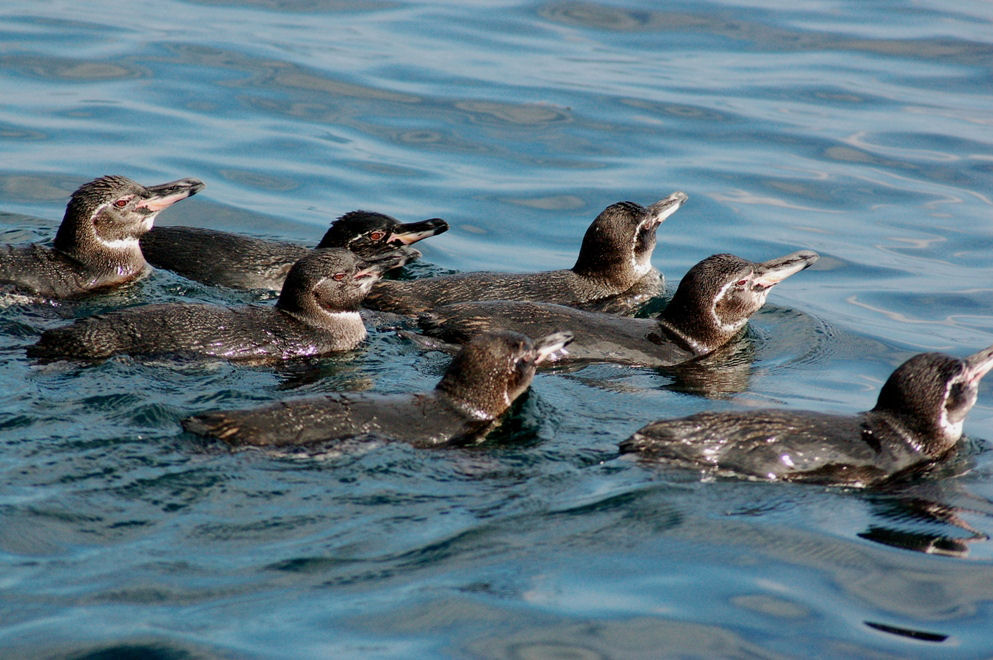
Galapagos Penguins
One of the most fascinating marine creatures on the archipelago is the Galapagos Penguin. Aren’t penguins those cold-weather tuxedoed outdoorsmen who shield each other from the cold by forming tight groupings so only those on the outside of the circle are hit by the violent elements in Antarctica? Aren’t they the animals that get trapped below the ice?  Don't they waver on the edges of ice flows waiting for the moment to jump into the frigid water to search for food? Yes, some penguins are – but not all.

Penguins SwimmingOur islands are blessed to be the indigenous home of the Galapagos Penguin.  This is the only species of penguin that lives above the Equator. They are able to do so because of the cool water temperatures that result from the Cromwell Currents. There are “warm water” Humboldt penguins along the coasts of continental Ecuador, Chile and Peru, but they do not go north of the Equator.


Wednesday, 8 August 2012

Galapagos Islands - An Overview and Visitor Site Information

Where are the Galapagos Islands? What are The Visitor Highlights?

Galapagos Islands map
Galapagos Islands Map From Wiki
The Galapagos Islands are spread out over a small piece of the Pacific Ocean and are remote from any other land mass. They are part of the country of Ecuador, but have many of their own laws and regulations, mostly focused on conservation and preservation of the land, sea and wildlife. When you come here, you have decisions to make about where to go, how strenuous your trip should be and how long to stay.

This post is meant to help you with these and many more questions. Here, I provide you with an overview of visitation to each of the Galapagos Islands, with some of their natural history and geography, along with the visitor site highlights of each Island. In addition, as I continue to blog about the Galapagos Islands, I will add links to detailed information about each site. As always, if you have questions, or you want more detail about anything mentioned in this article, please email me at [email protected].

The video below, by Alex Hantke of Aquasurround is one of the most beautiful you will ever see of the magnificent wild life, bird life and marine life you can expect to see when you visit the Galapagos Islands. It is a perfect introduction. Click here to see more of Alex's videos.


The Galapagos Islands are located about 600 miles off of the Pacific Coast of continental Ecuador. Though counted in different ways, they consist generally of 15 primary islands, 3-4 smaller islands and more than 100 rocks and islets. 
Thursday, 12 July 2012

Galapagos Marine and Land Iguanas

Recently, a tourist was found attempting to smuggle four iguanas out of the Galapagos Islands in a suitcase. This situation was horrible and thankfully the man was stopped and the iguanas are safe. The story created outrage, but it also reminded me that iguanas are a unique and amazing species. While there are still iguanas throughout the Islands, they have become extinct on several islands and are on the endangered species list.

At first glimpse, you might find these reptiles to be a bit ugly, even repulsive and scary; you wouldn’t want to face down one of these in a dark alley! But, a second look will probably change your mind. In fact, at second blush, it seems that many of these lizards are smiling. Take a look at this one from Sante Fe Island, for example:

You Have to Love Him!

Monday, 9 July 2012

Lonesome George- Part Two


Lonesome George
Post Update:  Ecuador has honored Lonesome George by listing him as part of the Nation's Cultural Heritage.  For a full article see: http://www.mnn.com/earth-matters/animals/stories/ecuador-honors-tortoise-with-national-heritage-nod


On a recent cruise around the Galapagos Islands I was lucky to have as guests a couple from Germany who took professional videos throughout the Islands. They were taking the videos for their company AquaSurround, which specializes in creating music and reflective environments that connect to sophisticated waterbed systems. These videos have been set to music and can be seen and heard on Youtube. They are some of the most beautiful and thoughtful Galapagos videos you will ever see and well worth watching.
Monday, 25 June 2012

Lonesome George - Part One


Lonesome George
Lonesome George
Lonesome George has died.  I like to think that he moved from Paradise on Earth to another kind of Paradise. 

Lonesome George I’ve been to the Charles Darwin Research Station on Santa Cruz Island at least 100 times. Each time George drew me in with his big black/brown sleepy eyes and his long neck. As he dawdled in the leaves, lumbered to his watering hole and lazed in the sun or shade, I wondered about him. Obviously he didn't think in words; neither English nor Spanish popped into his brain. But I observed that he experienced something, interacting with his surroundings, making decisions and providing sustenance for himself. He never seemed phased by our staring at him or studying him. He didn't seem to mind when we became paparazzi and took his picture for posterity.