Showing posts with label Tourist Sites. Show all posts
Wednesday 5 November 2014

When to Visit Galapagos - Part One

Welcome to Galapagos!


Sea Lions Welcome You at Puerta Villamil, Isabela Island, Galapagos

There's never a bad time to visit Galapagos and October and November are no exception. Though it's considered to be low season here, I think it's a marvelous time for a visit. The weather is great. The sights are as beautiful as at any other time of year. The animals come out to play. The flora has many brilliant colors that you don't see at other times of the year. And, the sky and water are glorious shades of blue. Not only that, it's been my experience that there may be fewer passengers on the ships and visitors at the hotels, so you could get a great rate - to say nothing of extra one-on-one attention. It seems like a great time to schedule your trip.
Tuesday 21 October 2014

Penguin Update

Galapagos Penguin photo by Joseph Tepper for the Audobon Society
When asked what they are most anxious to see on their Galapagos journey, many of my guests say Galapagos penguins. And, it's no wonder, the little penguins are absolutely as cute as can be. Everyone laughs, points with delight and pulls out their cameras when one or more pops his head out of the water near our panga or lulls about on the rocks near Bartolome, Fernandina or Isabela Islands. As I write this I hear my own voice saying "Penguinos" and pointing them out with great enthusiasm.
Tuesday 15 April 2014

Daphne Major and Daphne Minor


Daphne Major and Minor with Galapagos Sunset  by Daphne's Mom Flickr Creative Commons
Daphne Major at Sunset
Visitors will not be scheduled for landings on Daphne Major or Daphne Minor, and your boat is likely to circumvent these islands during your cruise. Still, the scientific research that occurs on these two islands is important. Both also provide excellent underwater diving opportunities.


Daphne Island approaching from a boat  by SATaylor Flickr Creative Commons
Daphne
Daphne Major consists of a tuff cone (for an explanation of tuff cones, see my earlier post on volcanoes) and a largely barren landscape. At its highest point the island is just 394 feet above sea level and it is 1.9 square miles in size.
Tuesday 31 December 2013

Pinta Island - The Northernmost Island


Satellite View of Pinta Island

Pinta Island (also known as Abington, but better known as named after Columbus' ship The Pinta) is a tiny spot representing less than 1% of the entire Galapagos land reserve (it is just 60 km in area). Its highest point is 2550 feet above sea level. Pinta is a shield volcano with numerous young cones and lava flows. Not only is Pinta the most northern of the Galapagos Islands, but also it hosts no visitor sites, other than one boat landing site, used primarily by scientists, on its northern shore called Punta Neros.

Volcanic Formations on Pinta
Pinta is an important island from the viewpoint of conservancy, preservation and species evolution. It is renowned for two significant reasons. It is best known for being the home of Lonesome George, the iconic Galapagos tortoise, the last of his species, who died in June 2012. Second, though remote and very small, this marvelous gem hosts nearly 1/3 of the native terrestrial plants in the Galapagos.

Monday 6 May 2013

Santa Cruz Island - Black Turtle Cove

Santa Cruz Island, Black Turtle Cove Panorama
Santa Cruz Island, Black Turtle Cove Panorama from Wiki
Located on the northern shores of Santa Cruz Island, Black Turtle Cove is a very special place; the atmosphere is quiet, contemplative and visual. Galapagos National Park rules require that upon your arrival at Black Turtle Cove via panga, the motor be turned off.  Silence and stillness permeate.  That is until you start to hear the sounds of nature all around you. Listen to the birds, hear the water and waves, listen for the sounds of fish jumping in the still waters, look around and smell the greenness of the mangrove trees that surround this beautiful area. In the panga you will navigate into the cove and then through the mangrove forest, sometimes paddling so as not to disturb the wildlife. The approach to the wildlife in silence assures that the nesting green sea turtles, sharks, herons and rays are allowed to remain peaceful and undisturbed in their natural habitat.

Approach to Black Turtle Cove
The mangroves themselves are beautiful, dense and diverse. Some are old; some new. They are not all alike; in fact, there are three mangrove species at Black Turtle Cove. Their root systems merge directly into the shallow blue saltwater of this cove. Their colors vary and the leaves sparkle where they are hit by the tropical sun.

Monday 15 April 2013

Santa Cruz - Charles Darwin Reseach Station


Entrance to Charles Darwin Research Station
Entrace to CDRS by Scott Abelman
The Charles Darwin Research Station on Santa Cruz Island near the town of Puerto Ayora, is one of the best known and most visited sites in all of the Galapagos. The CDRS is a joint effort of the Charles Darwin Foundation and the Galapagos National Park Service to protect, conserve, keep from extinction and repopulate the many Galapagos Tortoise species that are endemic to the islands.


Lonesome George and a Petite Female Galapagos Tortoise
George and a Female
CDRS was created in 1964 and its tortoise preservation program initiated in 1965. From 1971 until his death in June 2012, CDRS was the home of the biggest celebrity in the Galapagos Islands, Lonesome George. George, who lived at the CDRS for more than 40 years, was the last extant tortoise from Pinta Island and had, for many years, been the focus of concerted efforts to breed him with other similar, but not identical, tortoises. Unfortunately, all efforts failed and when George died, so did the species. For an extensive discussion of Lonesome George and the efforts to reproduce the species see my earlier post written right after his death. 
Monday 18 March 2013

Santa Cruz Island - Bachas Beach

Beautiful White Sand Bachas Beach

Bachas Beach on Santa Cruz Island is the first stop on many cruise itineraries, and a perfect place to introduce you to the Galapagos Islands. Here, from a beautiful white sand beach, you will be exposed to part of the rich human history of the Islands, both land and marine iguanas, nesting Galapagos green sea turtles, endemic flora, Sally Lightfoot Crabs, flamingos and pelagic birds, all to be topped off with a swim in the Pacific Ocean, replete with gorgeous vistas and the Galapagos blue sky. Heaven!

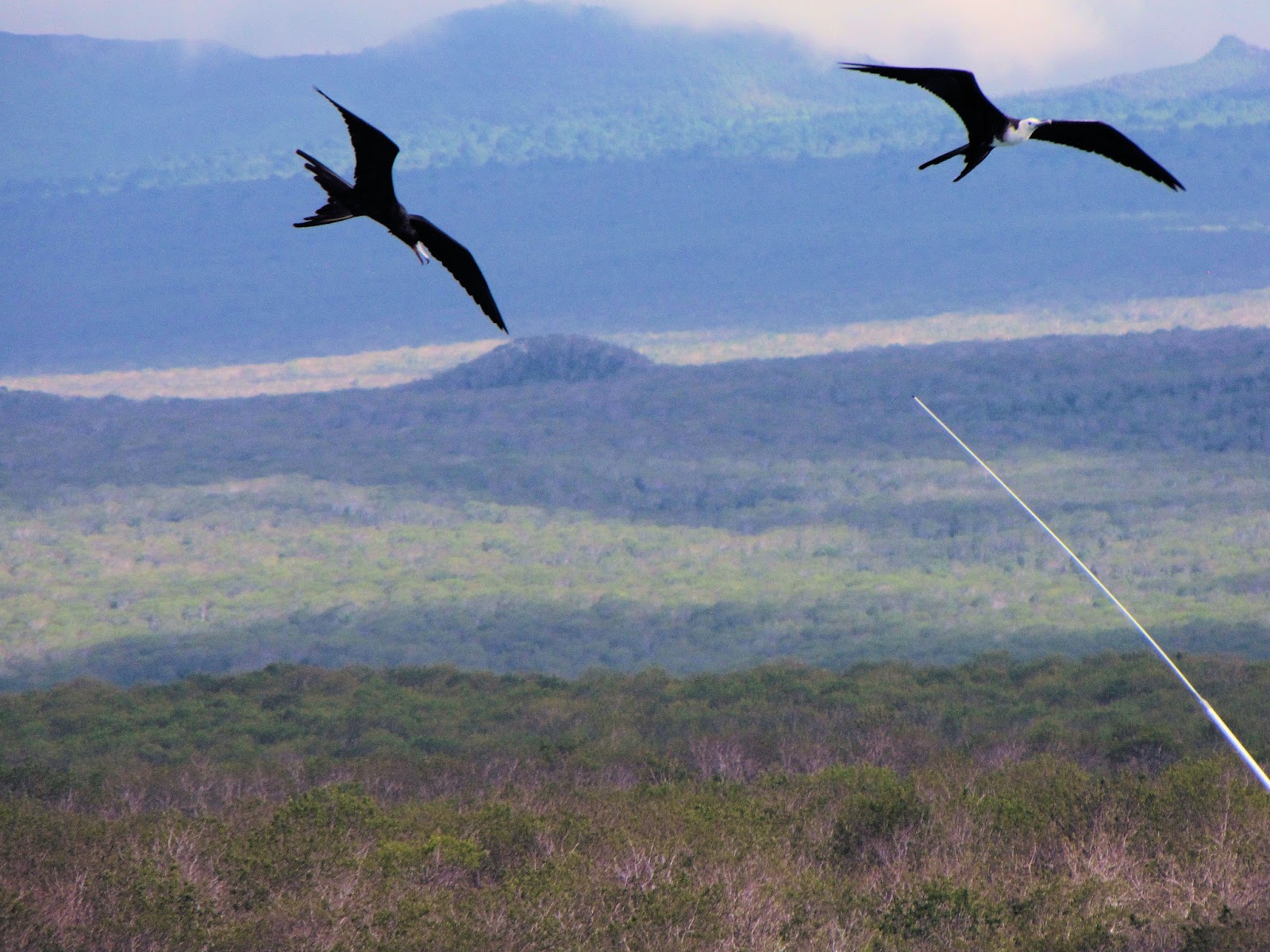
Frigate Birds Fly Above Bachas Beach
So, let’s begin our Bachas Beach journey. From your cruise ship, you will take a panga to a wet landing, meaning your feet dip into the Pacific Ocean for the first (but certainly not the last) time on your visit. You arrive on a pristine white sand beach and feel the warmth of the sand and sun. The walk here is not strenuous, but an opportunity to let the surroundings pull you in, to relax, to feel the uniqueness of the world around you and to put yourself in the moment - a place you will want to be throughout your Galapagos visit.


Friday 7 December 2012

Rabida Island


Approaching Rabida Island in the Galapagos from Boat
Approaching Rabida from Boat by Mark Putney


Don’t let its small size mislead you. Though just over 1.9 miles in total area with a maximum altitude of only 1200 feet, Rabida Island is filled with wonders that will captivate you. A veritable rainbow of color, texture, and light, this island hosts abundant flora and fauna, much of it endemic to the island. I don't get to Rabida as often as I get to many of the other Islands, but when I do it is a feast for my eyes, an opportunity for photographers to "go crazy" and a rare and much-loved treat for me.

Rabida is located in the center of the Galapagos Islands. It’s a marvelous area for snorkeling as the water teems with fish, marine iguanas and our beloved sea lions. It also offers a special and unique landscape, including the opportunity to walk on a rocky red sand beach.

Sunday 19 August 2012

Genovesa (Tower) Island Visitor Sites


Genovesa Island - Darwin Bay, Galapagos
Genovesa Island - Darwin Bay
Photograph from Galapagos National Park Service

Male Galapagos Frigate Bird displaying his red chest to a female

Galapagos Frigate Bird Chick
Frigate Bird Chic
The remote and isolated island of Genovesa is located on the north-east edge of the Galapagos archipelago. The fact of its remoteness contributes to its remaining among the most pristine of the islands, as well as one of the most coveted. Small, horseshoe shaped and precious in its unique blend of harsh volcanic terrain and natural beauty, it boasts a vast amount of birdlife; literally thousands of birds frequent this remote refuge and rely on it as their nesting site. While birdlife abounds, the island has no native land animals and no reptiles other than a small subspecies of marine iguana. Sea lions do lounge on the beaches. The pelagic birdlife that rely on Genovesa as a nesting site includes Frigatebirds, Red-Footed Boobies, Swallow-Tailed Gulls and Petrels by the thousands.
Monday 13 August 2012

Floreana Island

Sorting the Mail at the Post Office on Floreana Island with Harry Jimenez, owner of Galapagos Eco Lodge
Sorting the Mail at the Post Office on Floreana Island

Post Office Bay and Floreana Post Office

Evidence of Previous Visitors to the Post Office at Floreana Island
Evidence of Previous Visitors to the Post Office
Floreana, one of the oldest of the Galapagos Islands, and first settled in 1832, is named after Juan Jose Flores, the first president of Ecuador. Now, it is best known for the post office located at Post Office Bay, a brown sand beach inhabited by the ever-present Galapagos sea lions lounging in the sun. For nearly 2 ½ centuries – since 1793 – this unique Galapagos Island post office has been operating in the same fashion. Bring your mail and drop it off, addressed to go anywhere in the world. (On a cruise, your guide will likely provide you with brightly-colored post cards of indigenous animals for this purpose). Then, it’s your job to take a look through the mail that has been left by earlier visitors. If you come across a letter you are able to hand-deliver or mail to someone from your home town, you become the personal mail carrier. Hopefully, someone else will soon come along to carry your mail to your friend or family in the same way.  It’s as easy as that.
Thursday 9 August 2012

Fernandina Island - Espinosa Point and Mangle Point

map of Fernandina on the Left; Isabela on the Right
Fernandina on the Left; Isabela on the Right
Photograph From WikiCommons

Fernandina's Core Erupting in 2009, Galapagos
Fernandina's Core Erupting in 2009 from Nasa Image
The youngest of the Galapagos Islands, at just about 1,000,000 years old, Fernandina remains on the hot spot that created all of the islands. It is considered to be an active shield volcano with a large caldera, although the caldera collapsed in 1968. Fernandina is the westernmost and third largest of the Galapagos Islands. It most recently erupted in 2005 and 2009. The Island's landscape is dominated by La Cumbre Volcano.  The volcano's lava fields stretch all the way from the top of the volcano to the sea itself.

The Galapagos Conservancy and National Park are determined to keep Fernandina as pristine and untouched by humans and other non-endemic creatures as possible. So, although the Island is literally teeming with bird and marine life, there is only one approved visitation spot on the Island. But, it is really something special.

Bartolome Island - Pinnacle Rock and Beautiful Beaches


Bartolome Island; Pinnacle Rock
Photographed by AquaSurround
Bartholome Island has no human population, but is the home to one of the most recognized and photographed sites in all of the Galapagos Islands: Pinnacle Rock. The Island itself is located in Sullivan Bay to the east of Santiago Island. Because it offers such a spectacular view, most Galapagos travelers will find themselves enjoying the splendors of this island.

Steps on Bartolome with Galapagos Hawk Above
Photograph by AquaSurround
The Galapagos Conservancy has built a 600 meter wooden pathway with more than 300 steps to ensure that visitors are guided to the best spots with as little impact on the surrounding endemic vegetation, animal and birdlife as possible. Look carefully at the rock and lava formations on your way up the climb as you will see very interesting volcanic formations of spatter and tuff cones and lava flows.