Showing posts with label Galapagos Eco Lodge. Show all posts
Tuesday 26 May 2015

Volcan Wolf Erupts on Isabela Island

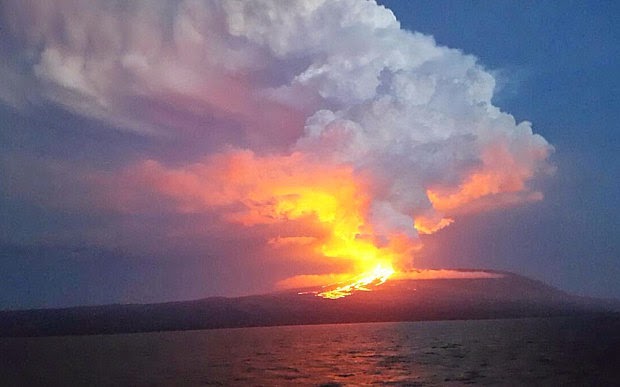
Volcan Wolf is erupting right now on Isabela Island for the first time since 1982. It's a spectacular sight to see. 


No human population will be harmed by the eruption. Importantly, the Galapagos National Park Service is reporting that our endemic pink iguana population is not currently at risk. It has been reported that the lava is flowing down the volcano's southern face but that the iguanas inhabit the other side of the volcano. The lava appears to be flowing into the sea, and there is no prediction as yet regarding any effect on marine life near the base of the volcano.


Visit the Galapagos Eco-Lodge facebook page for updates and our blog for more information about Volcan Wolf and our unique pink iguanas.http://blog.galapagosecolodge.net/2013/02/no-two-galapagos-iguanas-same.html; http://blog.galapagosecolodge.net/2012/10/isabela-island-visitor-sites-part-iii.html


Tuesday 22 April 2014

Palo Santo Trees

Palo Santa Galapagos Wikipedia Image
Common Palo Santo
One of the interesting and unique flora in the living museum of the Galapagos Islands is the Palo Santo tree. We have two species of these trees here, one endemic and one more widely seen throughout South America.  Bursera graveolens is native and Burseraceae is endemic, meaning it evolved in the Galapagos and can be found no where else in the world.  There are even some Palo Santo trees that appear to be a hybrid of the two classified species. Most of the year, the tree has a gray/white bark. During the rainy season it displays bright green leaves.


Palo Santos Line the Lava Fields
This tree is often called the Holy Stick, not only because of its appearance, but also because of the incense-like scent that emanates from the oil and resin in its branches. The aroma is pleasant and not harsh.  The smell of the branches is reminiscent of what you may have experienced in church. The words Palo Santo translate to "the saint's wood."  In fact, because of this distinguishing feature, the common variety of the tree is actually used to produce incense.
Tuesday 1 April 2014

Galapagos Eco-Lodge Featured in Video Review


The Galapagos Eco-Lodge is so proud to have been featured in a video review that we want to share it with all of our friends and guests.


To learn more, visit the Galapagos Eco-Lodge website and Facebook pages and see additional reviews in The New York Times and on Trip Advisor.


Tuesday 25 March 2014

Luxury Galapagos Style


My friend Ivan and I wrote and perform a song about the Galápagos Islands that is filled with joy and celebrates the natural beauty and magnificent animal and marine life surrounding us. If you listen to the video you'll get the essence of what makes this place we call Paradise so special. I invite you to watch the video and luxuriate in the magnificence we know as the Galápagos Islands.

The Galápagos Islands are unlike anywhere else in the world. That's why this is such a desirable destination. Guests from around the world come here expecting luxurious first class service - and they will get it. There's just one thing: luxury in the Galápagos Islands is unlike what you'll find at the Ritz or Four Seasons or even on Crystal Cruises. Let's call it pampering and opulence "Galapagos style."

Here's what I mean:
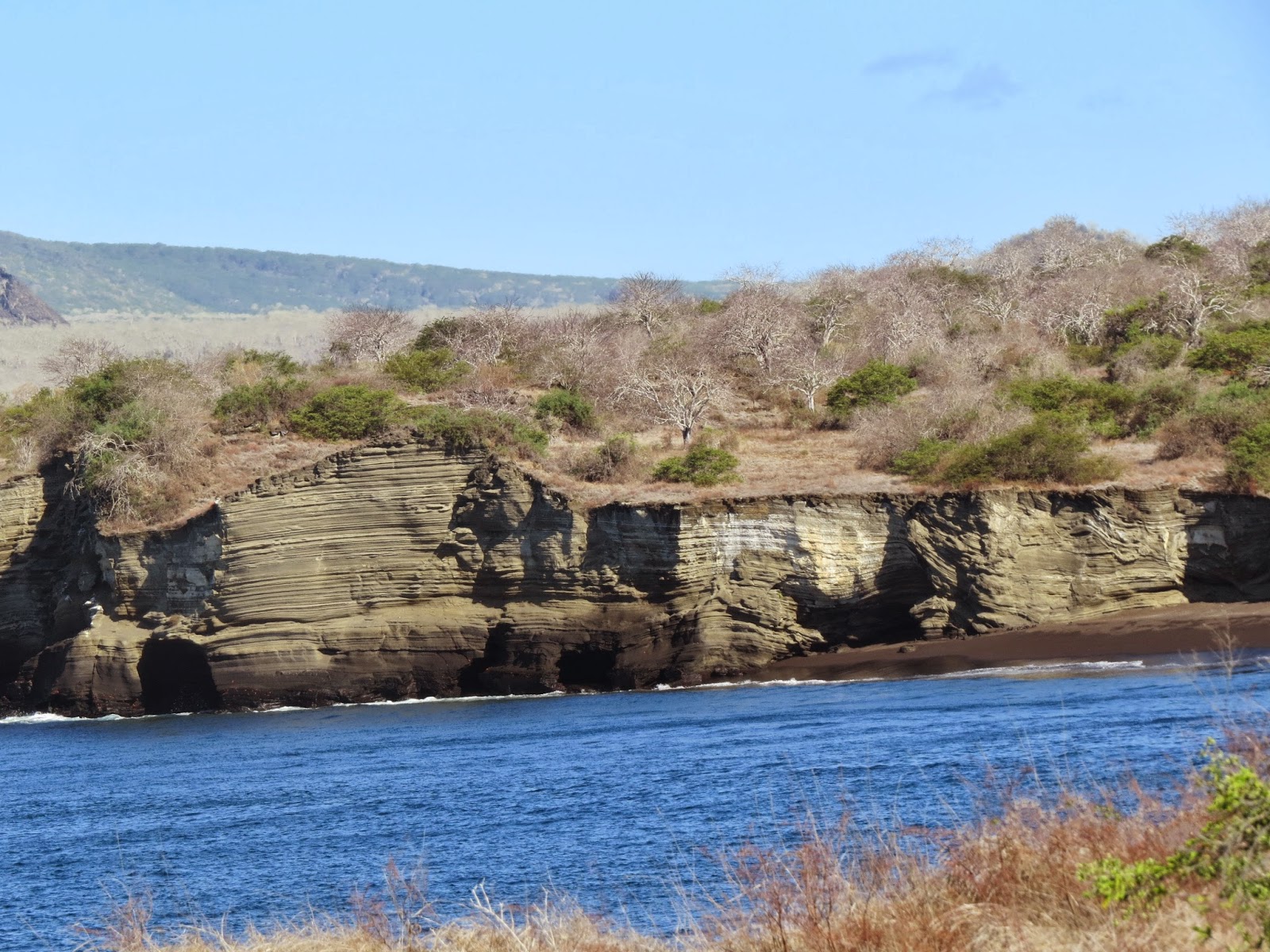
Galapagos Islands Volcanic cliffs
Cliffside Santiago Island Galapagos
You're on a beach vacation, but most of our beaches consist of rocky coastlines and volcanic ash. We don't have beachfront homes as in Palm Beach or beachfront resorts as in Maui. The beach - every bit of it - is national park and very well protected. Our beaches are still meant for sea lions and green sea turtle nests, for pelican mating and iguanas sunning - not for people.
Tuesday 21 January 2014

The Galapagos Sky

Recently, I decided to focus my camera on the sky in the Galapagos Islands.  Our sky is a phenomenon unto itself.  Together the ocean currents, the volcanic mountains and the wind create constant natural forces that affect and change the sky above us.  The mornings may be overcast or sunny. There may be a rainbow or glistening sun over a volcano.  As the sun rises in the sky, it may be covered in haze, blazing in a bright blue sky, or filled with puffy white clouds.


At sunset, the ball of fire sets in arrays of oranges, yellows and reds, sometimes bathing the surrounding lava in a golden glow.  At any time of day, it's filled with marine birds.  The sky here is always changing and always beautiful.


Tuesday 14 January 2014

San Cristobal's Wind Project - The Galapagos Eco-Lodge's Commitment to Fuel Conservation


Galapagos Eco Lodge lit at night by wind driven ecological power sourceThe Galapagos Eco-Lodge is committed to the environment and sustainability in more than words. It is not just our personal philosophy, but a pledge that we put into action every single day.

At the heart of this commitment is the elimination of environmental impact from the use of fossil fuels. Already, fully 60% of our power usage is from wind turbines.


wind turbines that provide power to the Galapagos Eco Lodge on San Cristobal Island
San Cristobal Island is my home and the location of the Galapagos Eco-Lodge. It is also the site of one of the most dramatic and important conservation efforts anywhere in the world – the San Cristobal Wind Project. As such, it makes it an ideal spot for the eco-tourist and, indeed, for anyone interested in preservation and conservation of our planet.


Wednesday 11 September 2013

Why Can't I See That Animal - Camouflage on the Galapagos Islands


The heads of these marine iguanas basking in the sun look just like the surrounding rocks.
Survival of the fittest. Adaptation of the species.

Familiar phrases, but what do they mean? In the simplest terms, they mean that animals have, over time, changed in ways that give them the ability to survive despite challenges in their environment. One such adaptation is the ability to change color to blend into the surrounding landscape, thus offering protection from predators. The volcanic land masses on the Galapagos Islands are predominantly shades of earthy tones in browns, tans, blacks, siennas, whites, grays and dusty greens. With few exceptions, this means the birds and wild life blend into their surroundings, protecting them from hawks and other prey.

In this post, I share with you some of my photos that graphically show how millions of years of adaptation protect our precious life forms.


You might walk by this bird's nest dozens of times before realizing its presence.
A little boobie chick hiding in the bushes.
  

Saturday 3 November 2012

Another Reason to Come to San Cristobal – Our Marvelous Coffee


Coffee Grows on San Cristobal Islands Coffee Plantation in the Galapagos Islands
Until now, it’s been at closely kept secret – or, at least I thought it was a secret. San Cristobal Island grows some of the best coffee beans anywhere in the world. Whether you’re waking up and ready for that first burst of flavor for the day or you’ve had a satisfying meal and want something special with your dessert, our coffee is the answer.

And you can visit San Cristobal's historic coffee plantation to see the old growth trees and taste the coffee yourself. This is a very special adventure and shows the diversity of the Galapagos Islands.


Special coffee from San Cristobal, Galapagos Islands Sold at StarbucksAs I said, I thought it was a secret. Now, I have discovered that Starbucks – the ubiquitous world wide coffee shop – has discovered this treasure too. In 2010 and again in 2012, it offered San Cristobal special blend coffee beans in limited qualities – all of which are gone now.


Sunday 16 September 2012

Galapagos Island Geography and Geology - Part Three - Ocean Currents


San Cristobal Island, Galapagos
San Cristobal Island
This is the final of a three-part series of articles in which I discuss the geology of the Galapagos Islands. In Part One I talked about the tectonic plates that lie beneath the sea and under the land and explained that without the constant movement of the tectonic plates, their crashing into one another, forcing the hot magma to break through the Earth's surface (called the lithosphere), there would be no Galapagos Islands at all. Part Two focused on the actual formation of the islands from volcanic action that occurs when those tectonic plates collide. Each and every one of the Galapagos Islands, their topography, the sheer cliffs that you see and that have become the nesting sites for bird and animal life found no where else on earth, the beautiful outcroppings, marine life, SCUBA sites, black sand beaches, crystalline beaches - all resulted from volcanic activity. Here, in Part Three, I will talk about the Pacific Ocean currents, particularly how the hot and cold currents impact and define the plant, animal, bird and marine life throughout the Galapagos Islands.
Tuesday 3 July 2012

About Me and Galapagos Eco Friendly

Photograph of Harry Jimenez, owner of San Cristobal's Galapagos Eco LodgeIf you love exploration, respect the environment, want to share in the conservation of the paradise we call the Galapagos Islands and yearn to experience first hand the miracles that Charles Darwin brought to the world, then the Galapagos Eco-Lodge is the place to begin your visit to the Galapagos Islands.


Puerto Baquerizo Moreno, San Cristobal Island with The Eco-Lodge is on the hillside overlooking the harbor and Pacific Ocean
Puerto Baquerizo Moreno, San Cristobal Island 
The Eco-Lodge is on the hillside 
overlooking the harbor and Pacific Ocean
My idea to build an environmentally sustainable "green" hotel began many years ago and has finally come to fruition.  It is my great pleasure to share the experience of how the hotel came to be built and the principles of preservation that motivated me with you. The hotel is the embodiment of my belief that every traveler to the Galapagos Islands should have the opportunity to live for a little while within our culture while exploring all the natural beauty of our National Park and Marine Reserve.  In this way, your travel and adventure will be enhanced as those of us who live in this paradise can share our knowledge and viewpoints with you.

Sunday 17 July 2011

Welcome to My Blog


Harry Jimenez, owner of Galapagos Eco Lodge
My name is Harry Jiménez.  The Eco-Lodge is my personal endeavor to create a hotel that focuses on preservation and conservation while it brings each of its visitors all the comforts of home.  It is the base for our travels around the Islands.  At the lodge, you will relax, swim, be introduced to our local culture and have private moments to contemplate and absorb the stunning sites and remarkable vistas that you are exposed to during each day of your stay.

I am the owner of the Galapagos Eco-Lodge and also the Expedition Leader and Naturalist Guide for all of the hotel-based tours.  I am certified by the Galapagos National Park Service and regularly serve as the Naturalist and guide on many of the most luxurious cruises serving the Galapagos Islands.  I personally coordinate and guide all of the activities and day trips of the hotel's guests and will serve as your guide for all of your activities in Ecuador-Galapagos Island, so get ready for an adventure of a lifetime!