Showing posts with label About the Galapagos Islands. Show all posts
Tuesday 6 October 2015

Eco-Tourism and Ethical/Responsible Travel – An Essential Combination

What is it about traveling that brings out the best in some and the worst in others? I'm not entirely sure but I've observed that the happiest, most relaxed of my guests (whether at the hotel or on a cruise ship) are those who come with the desire to immerse themselves in the experience. In most cases, these are the very same guests who have done research about our surroundings and our culture so that they are not surprised and they understand our basic customs and even our economies, just as we (the hosts if you will) have studied theirs. The result is mutual respect and the willingness and ability to learn from one another, enhancing everyone's time and experience. This, combined with a commitment to the environment and conservation, is central to the concept known as "ethical travel."

Anais Nin is credited with saying, “We travel, some of us forever, to seek other places, other lives, other souls.” Responsible travelers not only seek, but touch, others in a conscious and special way. They leave behind a special footprint, not one that harms or impacts the environment, but one that leaves a lasting and positive impression on those around them.
Thursday 10 September 2015

Frequently Asked Questions: What Should I Pack for my Galapagos Trip?

Packing for Galapagos can be something of an art form depending upon how long you are staying and some of your personal preferences. Here are a few thoughts to keep in mind as you get started:


Know how your day is likely to be arranged on a typical Galapagos cruise. Your day will generally be:
  - breakfast
   -a land-based activity, usually a hike but sometimes in Santa Cruz or        San Cristobal
   - lunch
   - snorkeling
   - another hike
   - a briefing and dinner


Thursday 3 September 2015

Frequently Asked Questions: How Much Should I Tip on a Galapagos Cruise Ship

This is the first of a series of blog posts in which I will focus on frequently asked questions about travel to Galapagos. Of all the questions I get, the most common is, "Should I tip on the cruise ship and, if so, how much?"


It might appear that, as a guide, I have a conflict of interests. So, when directly asked "How much?" by a cruise ship guest, I typically say something to the effect, "We always appreciate a tip and the amount is up to you." 

The truth is that the crew and guides on cruise ships usually do get tipped and rely on tips to supplement their income. Galapagos is a very expensive place to live; many things cost three times more than on the mainland. But, cruise ship salaries of guides and crew do not reflect that economic reality. This might be something to keep in mind when tipping.


Monday 24 August 2015

Galapagos and Beyond: Tortoise Population Recovery is a World-wide Effort

Giant Galapagos Land Tortoise
Our giant land-based endemic Galapagos Tortoises are a “must see” feature for most Galapagos visitors. Giant tortoises and the Galapagos Islands are, in many ways, synonymous, particularly when you consider that our islands are named in their honor. When the first explorers came to these islands and saw the hundreds of thousands of saddle back giant tortoises, they named the islands to reflect their discovery as the word “galapagos” means saddle in Spanish.


Tagus Cove Graffiti Reminds Us of Plundering Pirates

Of course, history now tells us that the same people who first came here and became so enamored, later destroyed the very tortoise population that intrigued them from the beginning. Pirates and other seafarers took tortoises by the hundreds, and even thousands, and threw them into the holds of their ships to eat, use for oil, and take home for trading. Many of the tortoises died on their journey, only to be thrown back into the sea.  Mankind also was a further catalyst for the reduction and extinction of the giant tortoise population when we introduced non-endemic species such as goats and rats to the islands. These predators soon attacked and ate the hatching tortoises.
Tuesday 14 April 2015

Sea Lions Too are Mama's Boys!


"Mama's boy" is at term usually used to describe a human male's exceedingly close relationship with his mother.  But, when you really think about it, I guess it should come as no surprise that human sons are not the only species that attach to their moms. That is exactly what the latest research about Galapagos Island sea lions, as reported in the journal Animal Behavior, has confirmed. Like many other species, such as Galapagos Blue Footed Boobies, the male sea lion doesn't venture far from his mom.


Male baby sea lions stay close to and rely on their moms for a much longer period than their female peers. Long after the little boys grow big enough to be capable of hunting and fishing, they still laze around dependently on their moms far after their sisters have ventured out on their own and learned to forage. It seems that the males have it made from a physical and (from what we as humans would refer to as a psychological) point of view.


Tuesday 7 April 2015

David Attenboro's Galapagos Adventure

I know from personal experience that there can never be too many photographs of the magnificent and diverse menagerie that inhabits the Galapagos Islands.  Here in Galapagos you will see an abundance of animals, birds and marine life. Not only that, it's almost impossible to take a bad photograph of the bounty that lives throughout Galapagos on the land and in the sea. And within that array, one baby sea lion after another presents a unique photo opportunity. Every so often, extraordinary photos are taken and shared with all of us, making our Galapagos vision even more exciting, inviting and memorable.
Tuesday 11 November 2014

More on Lonesome George - The Icon of Stubborness

In my blog, I focus on nature in Galapagos - the flora and fauna that define us and make us the most unique ecosystem anywhere in the world. One of the most iconic symbols of conservation in our archipelago is Lonesome George. When he died in September 2012, I wrote a commemorative post, thinking that would be my last about him, But, that's been far from true. I wrote about him again when he was officially designated as a symbol of our cultural heritage. Then, I posted on Facebook about the plan to taxidermy him and about his New York Museum show and ultimate return to Galapagos in 2015.  And, I anticipated writing an announcement when he finally returns to Galapagos. But, I never expected to be telling you about what has turned out to be one of his most enduring qualities: George was and remains one stubborn, I mean really stubborn, tortoise.
Tuesday 5 August 2014

In Galapagos We Preserve and We Evolve

Galapagos is THE PLACE for preservation of the species. Nowhere else in the world is so dedicated to maintaining a pristine environment, observing the rules of nature, limiting interference from any non-endemic and indigenous species and not only preserving, but also regenerating, the plant, animal, bird and marine life that makes our unique ecosystem.
Tuesday 29 July 2014

Fernandina's Fish-Eating Snakes - Adaptation of the Species in Action!

Cape Douglas
There’s a place on Fernandina Island in Galapagos not many are privileged to visit. A beautiful area for scuba diving and often reserved for scientists and naturalists, Cape Douglas, located on the Island’s northwest corner, is more than a little difficult to reach. It’s a ledge of 40 meters than falls precipitously one meter into the sea and into an area of the Pacific filled with marine creatures.
Tuesday 1 July 2014

China Hat (Sombrero Chino)

A stand-alone visitor destination in Galapagos, a small islet near Santiago Island, China Hat, also known as Sombrero Chino, is another island absolutely filled with things to see. As you can see from this photo, the island gets its name from its shape. In my last post, I told you about the tiny island of South Plaza. This island is equally tiny, less than 1/4 kilometer, but also equally exciting.
Tuesday 24 June 2014

South Plaza Island - Small and Mighty

South Plaza Sunrise Seen from the Panga
South Plaza is visited by many travelers who choose a cruise for their vacation to the Galapagos Islands. I've noticed that passengers might question what they can possibly experience here because as the cruise ship approaches South Plaza Island, they are likely to be a little underwhelmed by its size. After all its total area is just .08 square miles and at its highest point just 82 feet above sea level. (That's .13 km in area and 23 meters in altitude.)  But, I assure them that they will most certainly not be disappointed. South Plaza is beautiful and intriguing in every season. And it is teeming with colors, marine birds and, not surprisingly, sea lions.
Tuesday 10 June 2014

Tortoise World-Wide Celebration

We all love our Galapagos Tortoises.  I've already told you a lot about Lonesome George, the most famous tortoise ever, not only in Galapagos, but around the world.  And, if you've been following the Galapagos Eco-Lodge blog, you know that in Galapagos preservation of these marvelous and unique reptiles is a huge priority of the Charles Darwin Foundation.

But, it turns out that our Galapagos tortoises are not the only celebrated tortoises - not at all.  In fact, May 23, 2014 was actually the 14th celebration of international "World Turtle Day."  The day was dedicated to educating people about tortoises, turtles and worldwide conversation and preservation efforts.

The day is sponsored by American Tortoise Rescue, a non-profit organization with the mission to protect all species of tortoise and turtle. ATR has placed about 3000 tortoises in caring homes.

Before sharing some fabulous reptile photos with you, I want to take just a moment to tell you the major distinctions between tortoises and turtles.  A tortoise lives on the land, eats bushes, vegetation, grass, and cacti. Their feet have adapted for land mobility; thus they have heavily padded feet, instead of webs. Turtles, in contrast, live most of their life in the water, and have webbed feet for swimming. They stay in the water, like our green sea turtles, except when they come to shore to lay eggs or for a brief bask in the sun.

Some interesting facts:

Turtles can be tiny like this little Bog Turtle (photo courtesy of U.S Fish and Wildlife Service and popsci.com/article/science/its-world-turtle-day):


Tuesday 3 June 2014

Let's Save the Endangered Galapagos Mangrove Finch

Mangrove Finch from Save Our Species
Charles Darwin, on his well known and documented voyage to the Galapagos Islands, identified 16 species of finches.  These finches provided the underpinnings for his theory that species evolve to suit their environment.


Now, throughout Galapagos, there are only 15 species remaining, the rest having become extinct.

Medium Ground Finch, Kookr Flickr Creative Commons
In a recent post I told you how scientists are working with Galapagos finches to save them from an invading parasite.  Other scientists are doing work to save the Mangrove Finch, also nearing extinction and on the endangered species list.


Tuesday 20 May 2014

Galapagos Finches - From Darwin to the 21st Century

Most of us were taught in school that the bedrock of Darwin's book Origin of the Species and his theory of adaptation stemmed from his observation of finches in the Galapagos Islands. While on Galapagos, he collected and categorized finches from every island he visited, mostly as a study of what exists, but not why they exist.


It was only after he returned home to England and began studying his samples that he came to the realization that the birds from each island had developed slightly differently. Specifically, depending upon where they lived and the type of vegetation that was available on their particular island, they had developed unique beak styles that provided the best and most efficient access to their food source.
Tuesday 13 May 2014

The Mysterious Damsel Fish

If you follow my blog you know how much I love to treat my guests to adventures and give them unique memorable moments to remember. This passion of mine isn't limited to the land. I seek out teaching opportunities under water as well. One interesting member of the marine family we examine when snorkeling is the damselfish.


Take a look at this video from my YouTube Channel: Damselfish Providing Security Against Trespass.  

When we come across them on our snorkeling excursions, we put the damselfish's most interesting character trait to the test.
Tuesday 6 May 2014

Galapagos: A Hotbed of Scientific Exploration

One of the behind the scenes aspects of the Galapagos Islands, one that visitors and even natives rarely get to see, is the in-depth and often pivotal scientific research that happens on every island on an ongoing basis. I've written before about the finch research taking place on Daphne. And, I've also written extensively about work done constantly by the Charles Darwin Foundation, particularly with their tortoise breeding programs. The most famous of all is, of course, the effort made with the iconic Lonesome George.


But those are merely the best known of the projects. Research, study and observation are all critical components of our quest for maintaining the pristine quality and the ecological integrity of the islands.  In just the last month, results of two new studies were reported in scientific journals. They provide information critical to our understanding of the Galapagos Islands and, equally important, of how much harder we must continue to work to save and protect the biodiversity and natural order throughout the archipelago.
Tuesday 22 April 2014

Palo Santo Trees

Palo Santa Galapagos Wikipedia Image
Common Palo Santo
One of the interesting and unique flora in the living museum of the Galapagos Islands is the Palo Santo tree. We have two species of these trees here, one endemic and one more widely seen throughout South America.  Bursera graveolens is native and Burseraceae is endemic, meaning it evolved in the Galapagos and can be found no where else in the world.  There are even some Palo Santo trees that appear to be a hybrid of the two classified species. Most of the year, the tree has a gray/white bark. During the rainy season it displays bright green leaves.


Palo Santos Line the Lava Fields
This tree is often called the Holy Stick, not only because of its appearance, but also because of the incense-like scent that emanates from the oil and resin in its branches. The aroma is pleasant and not harsh.  The smell of the branches is reminiscent of what you may have experienced in church. The words Palo Santo translate to "the saint's wood."  In fact, because of this distinguishing feature, the common variety of the tree is actually used to produce incense.
Tuesday 8 April 2014

Charles Darwin Research Station - Fifty Years of Conservation

Charles Darwin Research Foundation
A "must see" destination for any visitor to the Galápagos Islands is The Charles Darwin Research Station. Once known primarily as the home of Lonesome George, now that George is gone, visitors are recognizing it for so much more: a major center for scientific study and the preservation of all species on the Galapagos Islands.


The scientists and conservationists responsible for founding the CDRS showed tremendous insight and foresight.  Long before conservation and sustainability were trendy, the CDRS saw that human intervention was needed to assure survival of the diversity and uniqueness of the Galapagos Islands.

Tortoise Breeding Project
This endeavour started in the 1950s when a young researcher, Irenäus Eibl-Eibesfeldt, came to the Galapagos Islands and became fascinated by the uniqueness of the islands fauna and flora, but likewise concerned about its future survival and the need for conservation.  He shared his findings with the International Union for Conservation of Nature (IUCN), among other organizations, and strongly advocated for a biological research station for study and laboratory experimentation. Originally established as a center for tortoise breeding projects, CDRS has expanded to the forefront of organizations determined to protect endangered species and restore them to unprotected status.
Tuesday 1 April 2014

Galapagos Eco-Lodge Featured in Video Review


The Galapagos Eco-Lodge is so proud to have been featured in a video review that we want to share it with all of our friends and guests.


To learn more, visit the Galapagos Eco-Lodge website and Facebook pages and see additional reviews in The New York Times and on Trip Advisor.


Tuesday 25 March 2014

Luxury Galapagos Style


My friend Ivan and I wrote and perform a song about the Galápagos Islands that is filled with joy and celebrates the natural beauty and magnificent animal and marine life surrounding us. If you listen to the video you'll get the essence of what makes this place we call Paradise so special. I invite you to watch the video and luxuriate in the magnificence we know as the Galápagos Islands.

The Galápagos Islands are unlike anywhere else in the world. That's why this is such a desirable destination. Guests from around the world come here expecting luxurious first class service - and they will get it. There's just one thing: luxury in the Galápagos Islands is unlike what you'll find at the Ritz or Four Seasons or even on Crystal Cruises. Let's call it pampering and opulence "Galapagos style."

Here's what I mean:
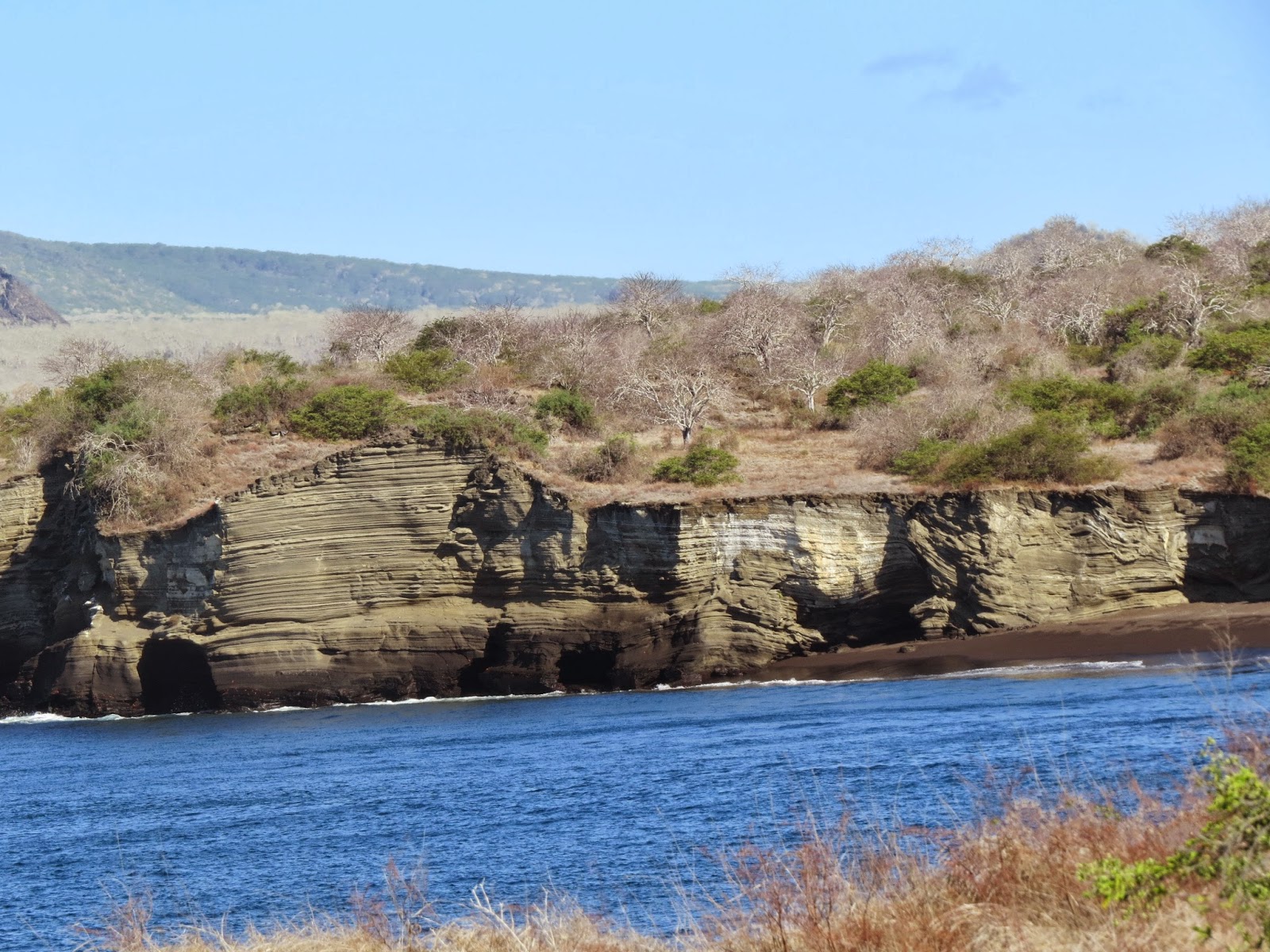
Galapagos Islands Volcanic cliffs
Cliffside Santiago Island Galapagos
You're on a beach vacation, but most of our beaches consist of rocky coastlines and volcanic ash. We don't have beachfront homes as in Palm Beach or beachfront resorts as in Maui. The beach - every bit of it - is national park and very well protected. Our beaches are still meant for sea lions and green sea turtle nests, for pelican mating and iguanas sunning - not for people.